Maharashtra evidence briefing
14 pages. Quantitative findings, primary sources, populations, existing provision and research limits.
Human-directed learning development
Five areas of learning. Practical child and adult actions. Evidence that helps us choose what to build next.
Open the meeting work01 / The proposed programme
Model a task. Let the child practise and explain. Change a relevant detail. Make the adult response part of the record.
A proposed teaching episode
Fictional characters and an accessible paper task. English meaning draft; age, language and classroom review are still required.
The teacher models a specific request. The adult offers a usable response.
A partner replies. The learner checks the meaning, then chooses a step and gives a reason.
The learner identifies missing information and asks the adult for it. Shape correction cannot solve this task.
If the adult or accessible material is unavailable, remedy provision. Do not mark child failure.
Proposed design, not a classroom result. No compulsory disclosure, ritual, calmness or judgement of a child's moral worth.
02 / Made for the meeting
Reviewed discussion materials from 7 October. File production and technical checks do not establish educational approval or audience acceptance.
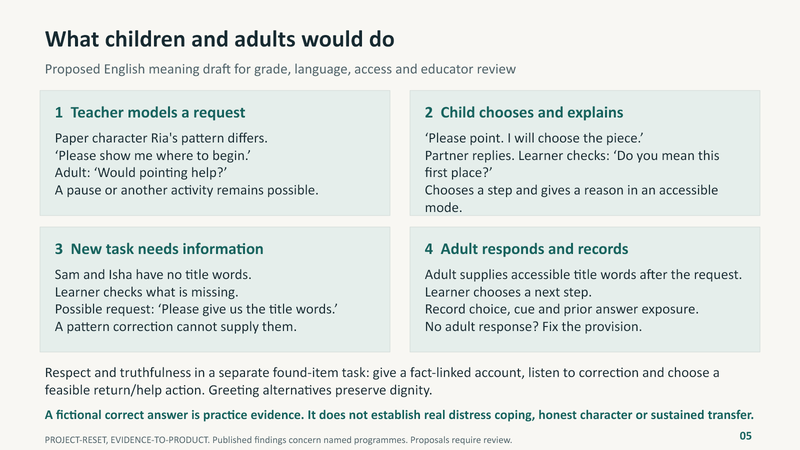 ACTUAL MEETING SLIDE / 05 OF 08
Eight-slide meeting deck · r6
All five areas, positive and null research, Maharashtra provision, a concrete teaching episode and a staged development proposal.
This public PDF uses rendered slides; use the readable route for selectable text. The editable public PowerPoint below has internal file-path citations removed from notes.
Download meeting PDF Read the speaking route ↗14 pages. Quantitative findings, primary sources, populations, existing provision and research limits.
4 printable pages. Five-area teaching traces, adult configurations, blank full-cost capture and human gates.
Sanitised derivative of r6: the eight slide bodies are unchanged; internal provenance paths are removed from speaker notes. No educational approval is implied.
About 650 words. Estimated five minutes before questions; no rehearsal has established the timing.
03 / Evidence explorer
Selected published findings from a targeted rapid overview. No new pooled analysis, one wellness percentage or measured Vedanta effect.
Intervals shown are 95% confidence intervals. g and SMD are standardised differences, not percentages. Different outcomes cannot share a ranking axis.
On a small screen, swipe the table sideways to read the estimate and population columns.
| Programme / outcome | Estimate & interval | Population & interpretation |
|---|
Maharashtra / actual usual provision
UDISE+ 2024–25: government: 64,884 schools / 5,108,544 enrolments; aided: 24,406 / 9,589,225. These are distinct system populations including foundational provision, not Classes 1–12-only or Vedanta reach.
School Health and Wellness Programme covers government/local-body and aided Classes 6–12. Mulyavardhan already includes cooperative activity and teacher rehearsal. Balbharati Class 4 examples address responsibility and respectful conversation; actual school edition and use remain unconfirmed.
Fair comparison: usual provision versus usual provision plus one fixed, reviewed Vedanta addition. Preserve usual support. Inspect the chosen grades, materials, language, routines, facilities and teacher time.
Read the UDISE+ source ↗04 / People & work profiles
18 installed AI work profiles, organised into five functional teams. Their roles describe intended functions, not hired humans, degrees or current activity.
Dated roster snapshot, 7 October 2026. Historical bounded work exists; this page does not report live execution, availability or simultaneous staffing. Team contacts coordinate work and do not approve their own output.
No matching role. Clear the search or choose another team.
05 / Actual status & next decisions
Document and artifact checks do not validate classroom effects or every source row.
No measured Vedanta effects, established price, superiority to government provision or cost savings are claimed. This is an inspectable development proposal, not a complete curriculum or intervention release.